
How I built my personal website with Antigravity
Time I spent: 2 hours
Code I typed: 0
The Itch to Build
For a long time, my personal website had fallen into a state of disrepair. It was originally built in the second half of 2024, designed by my wife, Aliena Cai, and implemented by me bit by bit.
At the time, I was completely unfamiliar with frontend development, so I built the site using Flask. The deployment was equally manual, relying on Lightsail and custom scripts. This clunky workflow made the process painful, and I eventually lost the enthusiasm to iterate on it.
Recently, "vibe coding" has become a massive trend. During my time at Google, I started incorporating it into my own workflow. I realized this was the perfect opportunity to apply the vibe coding philosophy to completely rewrite my personal website. I also wanted to modernize the deployment pipeline to ensure that future iterations would be much smoother.
Why Antigravity?
I've always considered myself an early adopter of "vibe coding." My journey actually began within Google, using our internal IDE, Cider. In the early days of AI-assisted programming, Cider quickly introduced AI features similar to GitHub Copilot in VS Code.
Following that, tools like Claude Code and Gemini CLI emerged. I tried Claude Code early on and was incredibly impressed. However, due to limited personal development needs at the time and internal restrictions at Google, I didn't use it extensively. On the other hand, the Gemini CLI became a favorite of mine; I still rely on it heavily for debugging and system design.
The most recent game-changer has been Jetski—the internal version of Antigravity. After using it a few times, Jetski quickly became my tool of choice, and I've used it for all my recent development work. When I recently tried Antigravity, I was delighted to find that it was virtually identical to Jetski. This discovery was thrilling because it meant I could finally merge my professional and personal development workflows. Naturally, Antigravity became the obvious choice for rewriting this website.
Speed of Thought
Here are a couple of interesting observations from the process:
1. The Seamless 30-Minute Migration My first meaningful step was migrating the entire tech stack from Python + Flask to Next.js 16, React 19, and Tailwind CSS 4. To my surprise, the entire rewrite took just 30 minutes. While configuring the deployment pipeline took a bit of extra effort, the core rewrite was shockingly simple. The most mind-blowing part? I didn't write a single line of code. I just directed the AI.
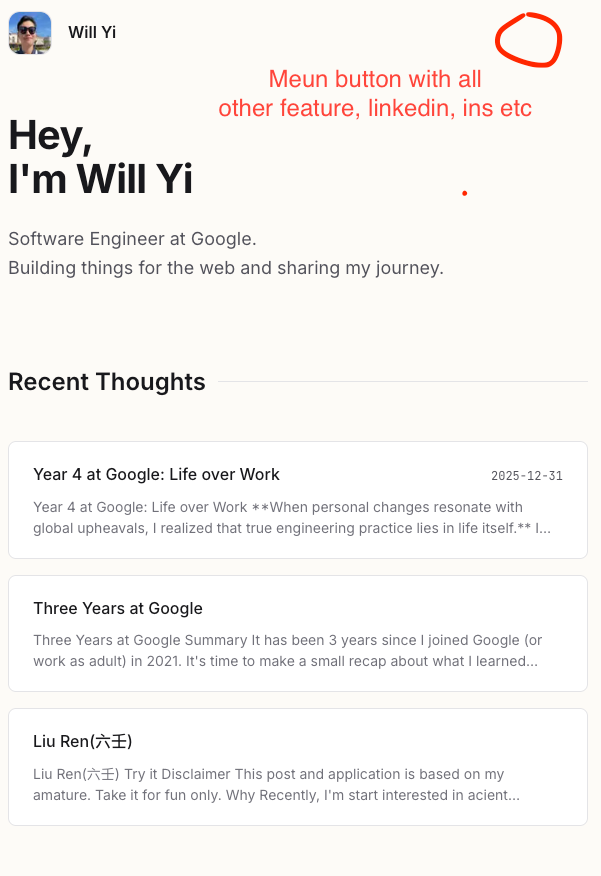
2. Two Hours to "Feature Complete" Once the foundation was laid, I spent about 2 hours adding features—implementing different themes, setting up the English/Chinese toggle, and polishing the UI. My interaction with the AI wasn't limited to text; I even started taking screenshots and drawing rough sketches to visually communicate exactly what I wanted. The AI picked up on these visual cues instantly.
A New Era of Builder
I am genuinely astounded by the pace of AI coding. In my early attempts at vibe coding, I had to act as a micromanager—providing detailed instructions and strictly validating every step. Today, I can provide high-level directives, and the AI delivers. It feels less like coding and more like steering.
For developers, this is a liberation. I feel like I have a team of solid senior engineers working alongside me (I know some who even run multiple Antigravity instances at once!). This shift allows us to focus on what truly matters: core system architecture and complex business logic, rather than getting bogged down in syntax, significantly accelerating our iteration speed.
For business owners and content creators, this is an unprecedented opportunity to scale personal influence. Programming is no longer a gatekept skill. Now, anyone can easily build a "good enough" product (a solid 60/100)—which, much like filing your own taxes, is often all a small business or individual needs to start creating value.